

Retirement at 55: Is It Possible, and What Does It Actually Cost?
Retiring at 55 is one of those goals people carry quietly for years without ever running the numbers. The financial system is largely built around age 65, and most conventional retirement advice follows that timeline. But retiring a decade earlier is genuinely achievable for many people — it just requires an honest look at what it actually costs and a plan built to handle the gaps.
Here’s what retirement at 55 really involves: the real costs, the rules that affect your money, and the planning decisions that make early retirement work.
Is Retiring at 55 Realistic?
Yes — but what’s realistic depends entirely on your situation. This isn’t a goal reserved for the ultra-wealthy. It does, however, require deliberate planning, ideally starting years before you want to stop working.
People who pull it off tend to share a few things in common: they saved aggressively during their working years, they had a clear picture of what retirement would cost them, and they built a plan that accounted for healthcare, taxes, and a potentially long retirement horizon.
If you’re 45 and just starting to think about this, you still have time. If you’re 50, the plan needs to be sharper. Either way, the first step is understanding what you’re actually planning for.
The Core Challenge: A Longer Retirement
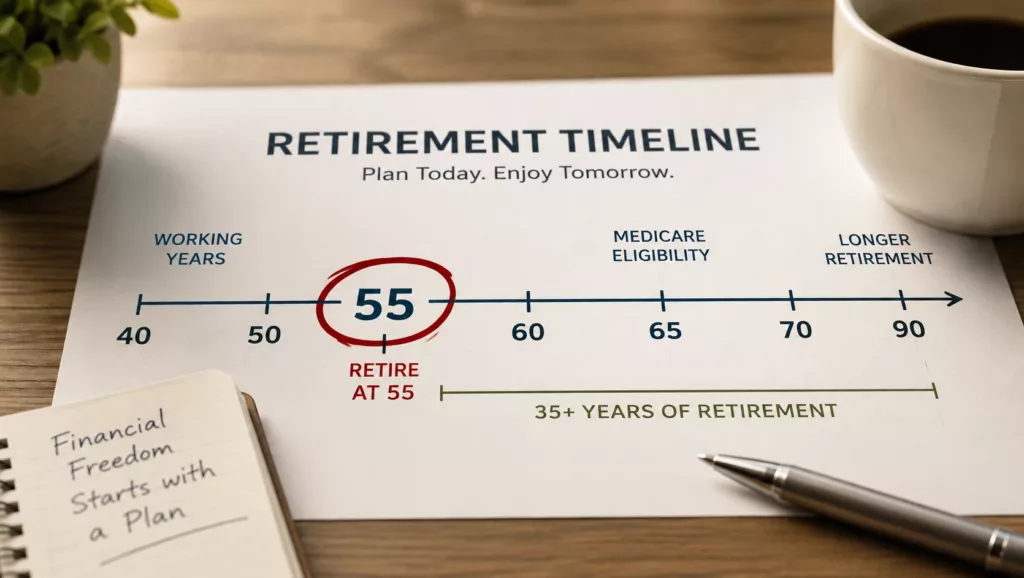
If you retire at 55 and live to 90, you’re funding 35 years of retirement. That’s not a minor adjustment from a standard retirement; it’s a fundamentally different financial challenge.
A longer retirement means more years of living expenses, more exposure to inflation, a higher risk of outliving your assets if your withdrawal rate is too aggressive, and a longer stretch without employer-sponsored health insurance before Medicare kicks in at 65.
The 4% withdrawal rule was developed with a 30-year retirement in mind. A 35-year retirement may require something closer to 3% to 3.5%, which means you need a larger portfolio to generate the same income.
What Does Retirement at 55 Actually Cost?
There’s no universal answer, but there is a framework that gets you close.
Step 1: Estimate Your Annual Expenses
Start with what you spend today and adjust for what retirement will actually look like. Some costs go down, like commuting, work clothes, maybe a second car. Others go up — travel, hobbies, healthcare.
A common planning target is 70% to 90% of your pre-retirement income, but that range is wide for a reason. If you plan to travel extensively or support adult children, 90% or higher may be more accurate. If you have a paid-off home and modest lifestyle goals, 70% might work.
Generic percentages are starting points, not answers. Run the actual numbers for your life. Then, if retirement is still a few years away, consider testing that budget now by living on your projected retirement income. It’s one of the best ways to determine whether that number is realistic and make adjustments while you still have time.
Step 2: Account for Healthcare
This is the expense that catches most early retirees off guard. Retiring at 55 means a 10-year gap before Medicare eligibility. Private health insurance through the marketplace can cost $700 to $1,500 or more per month for someone in their mid-50s, depending on the plan and where you live.
Over 10 years, that’s $84,000 to $180,000 in premiums alone before deductibles and out-of-pocket costs. Healthcare is often the single largest variable in an early retirement budget.
Some retirees bridge this gap through a spouse’s employer plan, COBRA for a limited period, or marketplace coverage. Each option carries different costs and coverage implications worth modeling carefully.
Step 3: Build Your Portfolio Target
Once you have an annual expense number, work backward. If you need $80,000 per year and plan to use a 3.5% withdrawal rate, you need a portfolio of roughly $2.3 million. At 4%, that drops to $2 million. At 3%, you’re closer to $2.7 million.
These figures don’t include Social Security, which you can begin collecting as early as 62 but will be reduced if you claim before your full retirement age. Many early retirees delay Social Security to maximize their monthly benefit, which means the portfolio has to carry more weight in the early years.
Step 4: Factor In Taxes
Tax planning in early retirement is easy to underestimate. If most of your savings are in traditional 401(k) or IRA accounts, every withdrawal is taxed as ordinary income. A large tax-deferred portfolio can create a surprisingly high tax bill once you start drawing it down.
Roth conversions in the years before retirement or during low-income years in retirement can significantly reduce your lifetime tax burden. This is one area where working with a CFP® professional tends to pay for itself.
The Rule of 55: What You Need to Know
A common misconception about early retirement is that you can’t touch your 401(k) before age 59½ without a penalty. That’s mostly true, but there’s an important exception.
The Rule of 55 allows penalty-free withdrawals from a 401(k) or 403(b) at your most recent employer if you leave that job in the calendar year you turn 55 or later. It applies only to that specific employer’s plan, not to IRAs or to old 401(k)s from previous jobs.
For early retirees who need to access retirement funds before 59½, this rule can be a meaningful bridge. It doesn’t eliminate income taxes on withdrawals, but it removes the 10% early withdrawal penalty.
One important detail: if you plan to use this strategy, the funds need to stay in your current employer’s plan. Rolling them into an IRA before you retire eliminates the Rule of 55 benefit entirely.
Social Security and Early Retirement
Retiring at 55 means you won’t be drawing Social Security for at least seven years and possibly longer if you delay to maximize your benefit.
Claiming at 62 locks in a permanently reduced benefit, roughly 25% to 30% less than your full retirement age amount. Waiting until 70 increases your benefit by 8% per year beyond full retirement age.
For most early retirees, the math favors delaying Social Security as long as the portfolio can support it. But the right answer depends on your health, your other income sources, and your spouse’s situation if that applies.
What a Real Plan Looks Like
A workable retirement-at-55 plan typically involves several layers working together:
Taxable brokerage accounts for flexible, penalty-free access in the early years of retirement.
Rule of 55 withdrawals from a current employer’s 401(k) if applicable.
Roth IRA contributions (not earnings), which can be withdrawn at any time without penalty.
Roth conversions in low-income years to reduce future required minimum distributions and taxes.
Delayed Social Security to maximize the monthly benefit that will eventually serve as a guaranteed income floor.
A healthcare funding strategy that explicitly plans for the gap between 55 and 65.
None of these pieces work in isolation. The sequencing matters, and mistakes in the early years — drawing down the wrong accounts, triggering unnecessary taxes, underestimating healthcare costs — can compound over a 35-year horizon in ways that are hard to recover from.
Getting the Plan Right
Retirement at 55 is achievable, but it’s not a set-it-and-forget-it decision. It requires coordinating investments, taxes, healthcare, Social Security timing, and estate planning in a way that holds together over decades.
Working with a CFP® professional who builds personalized financial plans, not generic ones, makes a real difference at this level of complexity. At Korhorn Financial Group, the planning process starts with understanding your specific goals and financial picture, then builds a roadmap designed to get you where you want to go without leaving gaps that cost you later.
If retiring at 55 is something you’re seriously considering, the best time to build the plan is before you need it, and the sooner you build a plan around the actual numbers, the better your chances of making it work.
Frequently Asked Questions
In some cases, yes. The Rule of 55 allows penalty-free withdrawals from a 401(k) at your most recent employer if you separate from service in the year you turn 55 or later. Roth IRA contributions (not earnings) can also be withdrawn at any time without penalty. IRAs and old 401(k)s from previous employers don’t qualify for the Rule of 55.
It depends on your annual expenses and withdrawal rate. A common approach is to divide your expected annual spending by your withdrawal rate. For example, $80,000 in annual expenses at a 3.5% withdrawal rate requires roughly $2.3 million. Healthcare costs, taxes, and Social Security timing all affect this number significantly.
You’re not eligible for Medicare until 65, so you’re looking at a 10-year gap. Options include staying on a spouse’s employer plan, purchasing marketplace coverage through the ACA, or using COBRA for a limited time. Private coverage for someone in their mid-50s can cost $700 to $1,500 or more per month, so this expense needs to be built into your retirement budget from the start.
Claiming at 62 reduces your monthly benefit permanently — roughly 25% to 30% compared to your full retirement age amount. Most early retirees benefit from delaying Social Security as long as their portfolio can support it, since the higher monthly payment provides a stronger income floor later in life. The right timing depends on your health, other income sources, and overall plan.
Significantly. At 3% annual inflation, your purchasing power roughly halves over 24 years. A retirement budget that works at 55 may feel tight at 75 if it wasn’t designed with inflation in mind. Your portfolio needs to include assets that grow over time, not just generate income to keep pace with rising costs.
The traditional 4% rule was designed for a 30-year retirement. A 35-year retirement, which is realistic if you retire at 55 and live into your late 80s or 90s, generally calls for something more conservative, around 3% to 3.5%. That means you need a larger portfolio to generate the same annual income, which is one reason early retirement planning needs to start well in advance.
Not legally, but the complexity involved with coordinating tax strategy, account sequencing, healthcare funding, and Social Security timing over a 35-year horizon makes professional guidance genuinely valuable. Mistakes made in the first few years of retirement can have lasting consequences that are difficult to reverse.
Brandon Stoller is a CERTIFIED FINANCIAL PLANNER™ at Korhorn Financial Group. He also holds his Certified Kingdom Advisor® (CKA®) designation.